400 128 6709

行业新闻
 发布时间:2025-07-24
 点击次数:
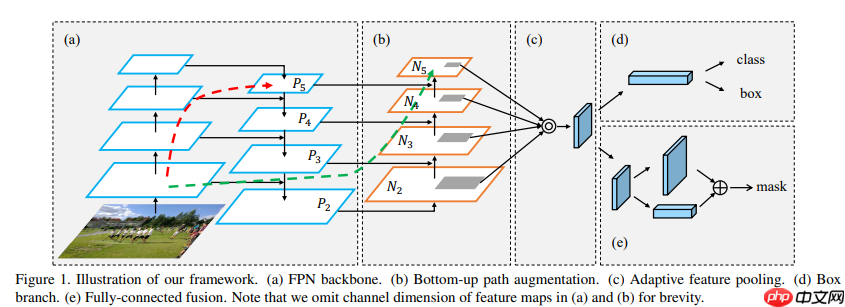
点击次数: 本文是FPN综述教程,先介绍FPN开山之作,含简介、相关工作、结构及基于ResNet18的代码实现。还讲解了PAFPN,其在FPN基础上增加自底向上路径,给出结构与代码。最后阐述BiFPN,包括简介、结构及多特征图示例的代码实现。
☞☞☞AI 智能聊天, 问答助手, AI 智能搜索, 免费无限量使用 DeepSeek R1 模型☜☜☜
- 鸽了好久的项目,看平台对FPN介绍不多,我来捡个漏。
- 带大家逐行coding
论文链接Feature Pyramid Networks for Object Detection
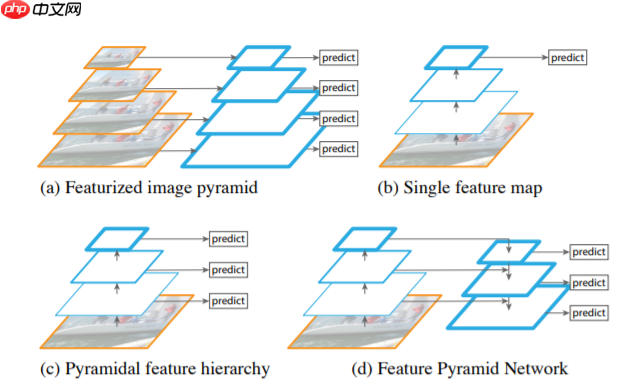
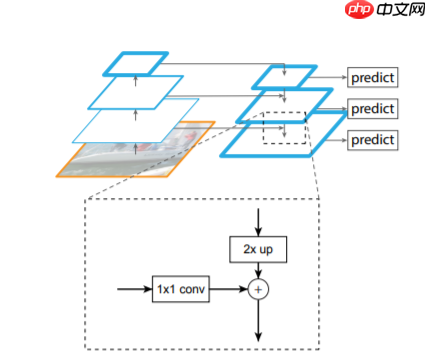
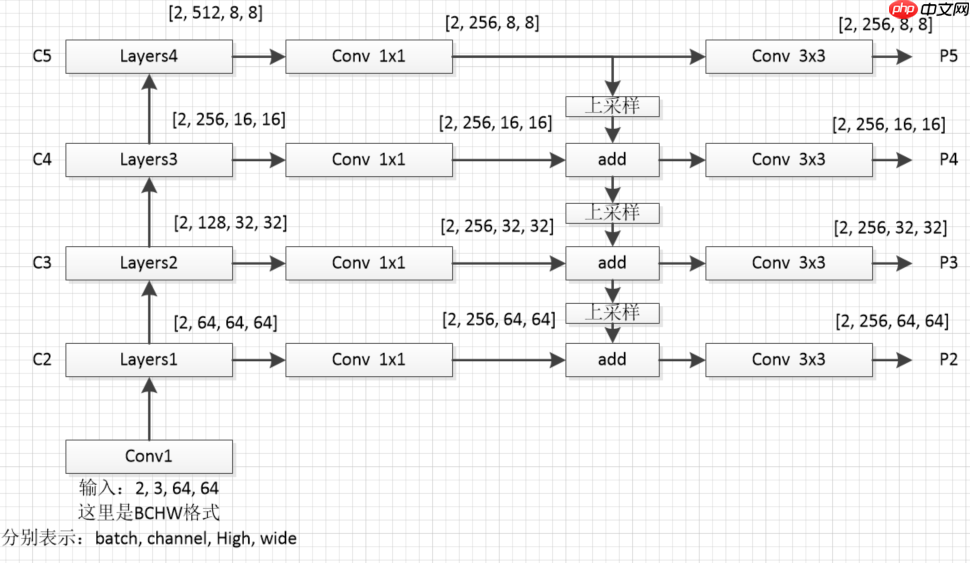
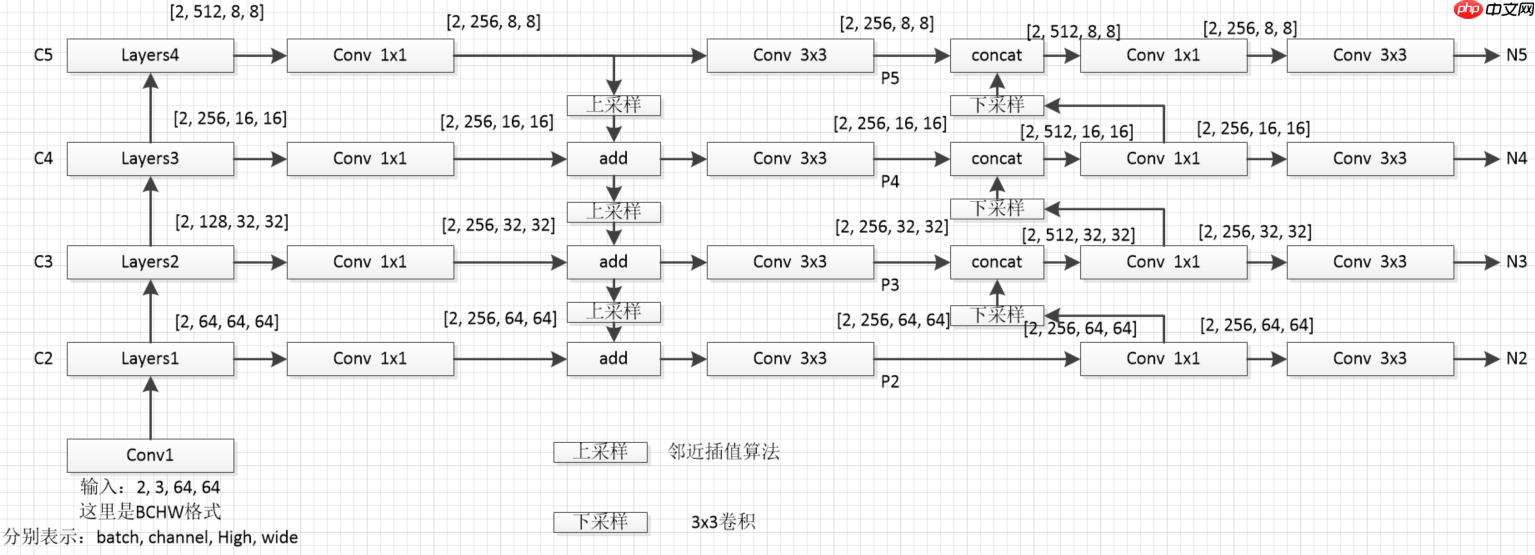
- 为了防止大家迷糊,我这里对上图从新绘制个细节图如下(这里我采用的是resnet18作为特征提取网络)
# 导入相关的包import paddleimport paddle.nn.functional as Fimport paddle.nn as nn
# 构建resnet18的基础模块# Identity模块表示没有任何操作class Identity(nn.Layer):
    def __init_(self):
        super().__init__()    def forward(self, x):
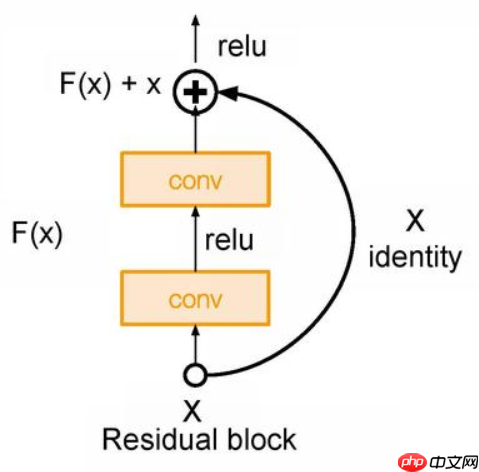
        return x# Block模块是构成resnet的主要模块# 通过判断步长(stride == 2)和通道数(in_dim != out_dim)# 判断indentity = self.downsample(h)中,self.downsample()下采样方式class Block(nn.Layer):
    def __init__(self, in_dim, out_dim, stride):
        super().__init__()        ## 补充代码
        self.conv1 = nn.Conv2D(in_dim, out_dim, 3, stride=stride, padding=1, bias_attr=False)
        self.bn1 = nn.BatchNorm2D(out_dim)
        self.conv2 = nn.Conv2D(out_dim, out_dim, 3, stride=1, padding=1, bias_attr=False)
        self.bn2 = nn.BatchNorm2D(out_dim)
        self.relu = nn.ReLU()        if stride == 2 or in_dim != out_dim:
            self.downsample = nn.Sequential(*[
                nn.Conv2D(in_dim,out_dim,1,stride=stride),
                nn.BatchNorm2D(out_dim)])        else:
            self.downsample = Identity()    def forward(self, x):
        ## 补充代码
        h = x
        x = self.conv1(x)
        x = self.bn1(x)
        x = self.relu(x)
        x = self.conv2(x)
        x = self.bn2(x)
        indentity = self.downsample(h)
        x = x + indentity
        x = self.relu(x)        return x
In [3]
# 搭建resnet18主干网络class ResNet18(nn.Layer):
    def __init__(self, in_dim=64):
        super().__init__()
        self.in_dim = in_dim        # stem layer
        self.conv1 = nn.Conv2D(in_channels=3,out_channels=in_dim,kernel_size=3,stride=1,padding=1,bias_attr=False)
        self.bn1 = nn.BatchNorm2D(in_dim)
        self.relu = nn.ReLU()
        #blocks
        self.layers1 = self._make_layer(dim=64,n_blocks=2,stride=1)
        self.layers2 = self._make_layer(dim=128,n_blocks=2,stride=2)
        self.layers3 = self._make_layer(dim=256,n_blocks=2,stride=2)
        self.layers4 = self._make_layer(dim=512,n_blocks=2,stride=2)    def _make_layer(self, dim, n_blocks, stride):
        layer_list = []
        layer_list.append(Block(self.in_dim, dim, stride=stride))
        self.in_dim = dim        for i in range(1,n_blocks):
            layer_list.append(Block(self.in_dim, dim, stride=1))        return nn.Sequential(*layer_list)    def forward(self, x):
        # 创建一个存放不同尺度特征图的列表
        fpn_list = []

        x = self.conv1(x)
        x = self.bn1(x)
        x = self.relu(x)
        x = self.layers1(x)        # x [2, 64, 64, 64]
        fpn_list.append(x)

        x = self.layers2(x)        # x [2, 128, 32, 32]
        fpn_list.append(x)

        x = self.layers3(x)        # x [2, 256, 16, 16]
        fpn_list.append(x)

        x = self.layers4(x)        # x [2, 512, 8, 8]
        fpn_list.append(x)        return fpn_list
In [4]
# FPN构建# fpn_list中包含以下特征维度,对应章节1.3中的图# C2 [2, 64, 64, 64]# C3 [2, 128, 32, 32]# C4 [2, 256, 16, 16]# C5 [2, 512, 8, 8]class FPN(nn.Layer):
    def __init__(self,in_channel_list,out_channel):
        super(FPN, self).__init__()
        self.inner_layer=[]  # 1x1卷积,统一通道数
        self.out_layer=[]  # 3x3卷积,对add后的特征图进一步融合
        for in_channel in in_channel_list:
            self.inner_layer.append(nn.Conv2D(in_channel,out_channel,1))
            self.out_layer.append(nn.Conv2D(out_channel,out_channel,kernel_size=3,padding=1))    def forward(self,x):
        head_output=[]  # 存放最终输出特征图
        corent_inner=self.inner_layer[-1](x[-1])  # 过1x1卷积,对C5统一通道数操作
        head_output.append(self.out_layer[-1](corent_inner)) # 过3x3卷积,对统一通道后过的特征进一步融合,加入head_output列表
        print(self.out_layer[-1](corent_inner).shape)
        for i in range(len(x)-2,-1,-1):  # 通过for循环,对C4,C3,C2进行
            pre_inner=corent_inner
            corent_inner=self.inner_layer[i](x[i])  # 1x1卷积,统一通道数操作
            size=corent_inner.shape[2:]  # 获取上采样的大小(size)
            pre_top_down=F.interpolate(pre_inner,size=size)  # 上采样操作(这里大家去看一下interpolate这个上采样api)
            add_pre2corent=pre_top_down+corent_inner  # add操作
            head_output.append(self.out_layer[i](add_pre2corent))  # 3x3卷积,特征进一步融合操作,并加入head_output列表
            print(self.out_layer[i](add_pre2corent).shape)
        return head_output# head_output 中包含以下特征维度,对应章节1.3中的图# P5 [2, 256, 8, 8]# P4 [2, 256, 16, 16]# P3 [2, 256, 32, 32]# P2 [2, 256, 64, 64]
In [ ]
model = ResNet18()# print(model)# [64,128,256,512]表示输入特征通道数的列表(C2-C5的通道数列表),256表示过FPN后最终通道数(P2-P5的通道数)fpn=FPN([64,128,256,512],256)
x = paddle.randn([2, 3, 64, 64])
fpn_list = model(x)
out = fpn(fpn_list)# print(list(reversed(out)))
/opt/conda/envs/python35-paddle120-env/lib/python3.7/site-packages/paddle/nn/layer/norm.py:653: UserWarning: When training, we now always track global mean and variance.
  "When training, we now always track global mean and variance.")
[2, 256, 8, 8]
[2, 256, 16, 16]
[2, 256, 32, 32]
[2, 256, 64, 64]
 Lar*al 9 保姆级教程——相关课件
Lar*al 9 保姆级教程——相关课件
 61
查看详情
61
查看详情

# 构建一个用于下采样的卷积池化模块class ConvNormLayer(nn.Layer):
    def __init__(self, in_channel, out_channel, kernel_size, stride, padding=1):
        super(ConvNormLayer, self).__init__()
        self.conv = nn.Conv2D(in_channel, out_channel, kernel_size, stride, padding)
        self.norm = nn.BatchNorm2D(out_channel)    def forward(self, inputs):
        out = self.conv(inputs)
        out = self.norm(out)        return out
In [ ]
# PAFPN构建# fpn_list中包含以下特征维度,对应章节2.1中的图# C2 [2, 64, 64, 64]# C3 [2, 128, 32, 32]# C4 [2, 256, 16, 16]# C5 [2, 512, 8, 8]class PAFPN(nn.Layer):
    def __init__(self,in_channel_list,out_channel):
        super(PAFPN, self).__init__()
        self.fpn = FPN(in_channel_list, out_channel)
        self.bottom_up = ConvNormLayer(out_channel, out_channel, 3, 2)  # 2倍下采样模块
        self.inner_layer=[]  # 1x1卷积,统一通道数,处理P3-P5的输出,这里要注意P2和P3-P5的输入通道是不同的,可以看2.1图3,
        self.out_layer=[]  # 3x3卷积,对concat后的特征图进一步融合
        for i in range(len(in_channel_list)):            if i==0:
                self.inner_layer.append(nn.Conv2D(out_channel, out_channel,1))  # 处理P2
            else:
                self.inner_layer.append(nn.Conv2D(out_channel*2, out_channel,1))  # 处理P3-P5
            self.out_layer.append(nn.Conv2D(out_channel,out_channel,kernel_size=3,padding=1))    def forward(self,x):
        head_output=[]  # 存放最终输出特征图
        fpn_out = self.fpn(x)  # FPN操作
        print('------------FPN--PAFPN--------------')  # PAFPN操作分割线
        corent_inner=self.inner_layer[0](fpn_out[-1])  # 过1x1卷积,对P2统一通道数操作
        head_output.append(self.out_layer[0](corent_inner))  # 过3x3卷积,对统一通道后过的特征进一步融合,加入head_output列表
        print(self.out_layer[0](corent_inner).shape)        for i in range(1,len(fpn_out),1):
            pre_bottom_up = corent_inner
            pre_concat = self.bottom_up(pre_bottom_up)  # 下采样
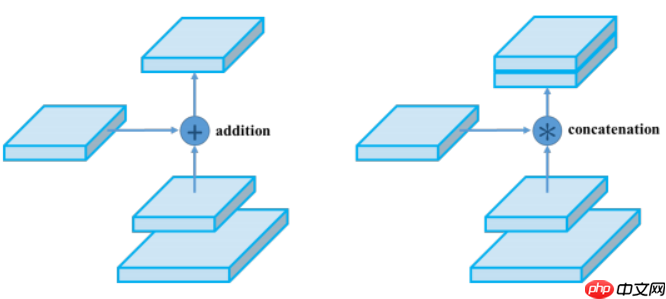
            pre_inner = paddle.concat([fpn_out[-1-i],pre_concat], 1)  # concat
            corent_inner=self.inner_layer[i](pre_inner)  # 1x1卷积压缩通道
            head_output.append(self.out_layer[i](corent_inner))  # 3x3卷积进一步融合
            print(self.out_layer[i](corent_inner).shape)
        return head_output# head_output 中包含以下特征维度,对应章节1.3中的图# N2 [2, 256, 64, 64]# N3 [2, 256, 32, 32]# N4 [2, 256, 16, 16]# N5 [2, 256, 8, 8]
In [ ]
model = ResNet18()# print(model)# [64,128,256,512]表示输入特征通道数的列表(C2-C5的通道数列表),256表示过FPN后最终通道数(P2-P5的通道数)pafpn=PAFPN([64,128,256,512],256)
x = paddle.randn([2, 3, 64, 64])
fpn_list = model(x)
out = pafpn(fpn_list)
[2, 256, 8, 8]
[2, 256, 16, 16]
[2, 256, 32, 32]
[2, 256, 64, 64]
------------FPN--PAFPN--------------
[2, 256, 64, 64]
[2, 256, 32, 32]
[2, 256, 16, 16]
[2, 256, 8, 8]
In [5]
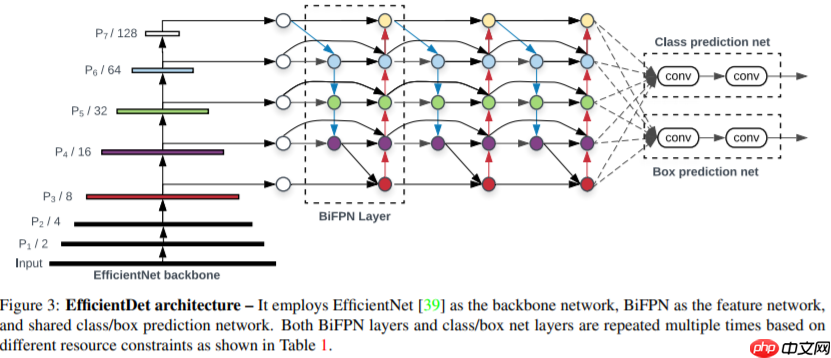
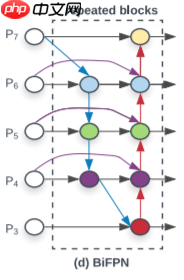
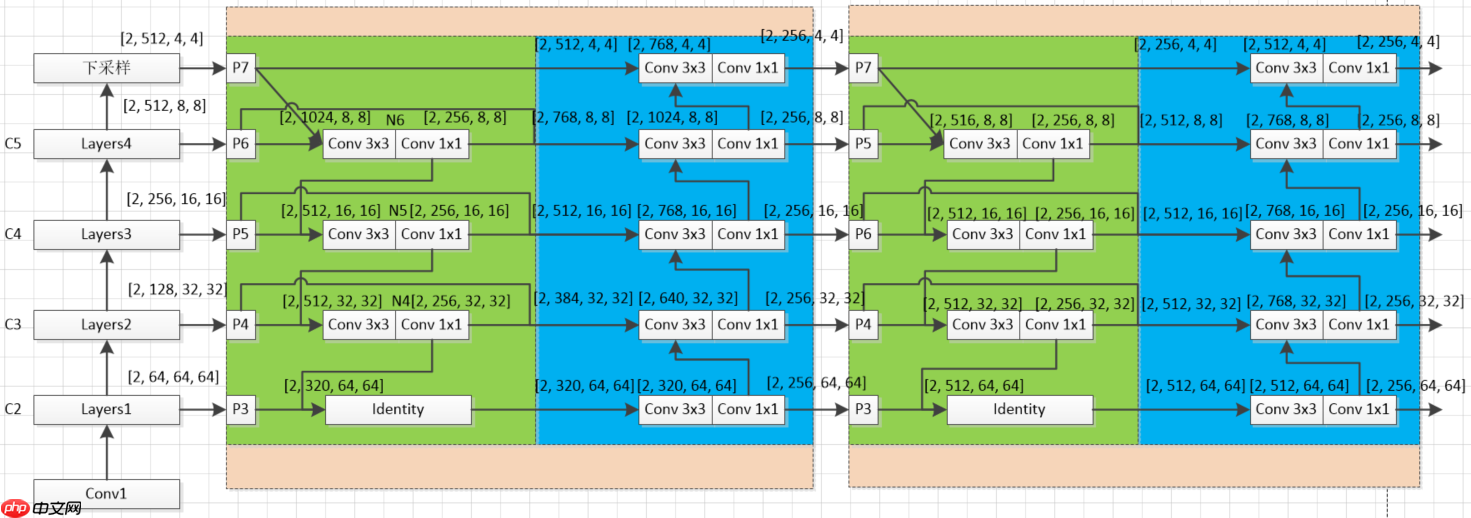
- 图中各个模块说明:(这里没有对原论文加入注意力机制进行实现,只是实现了模型结构,并略微改进了构建方式)
- C(2-5)到P(3-7)下采样块 C_to_P:将C(2-5)四个特征图变为P(3-7)五个特征图(原论文是将3个变为5个,下采样方法一样),图中的P(3-7)块没有任何操作,只是个标识
- 1x1和3x3卷积模块Sepconv_BN_Swish:构建3.1节每个彩色节点模块
- 绿色块BiFPN_block1:这里跟原论文代码构建方式不同,原论文是通过一层层进行搭建,这样限定了输入必须是五个特征图,本项目的搭建方式可以实现n个(3
- 蓝色块BiFPN_block2:接受BiFPN_block1传出特征图,同样连接方式采用concat方式,下采样采用最大池化方式
- 橙色块BiFPN_block:表示BiFPN_block1、BiFPN_block2共同组合一个BiFPN_block模块,这里第一个BiFPN_block与第二个BiFPN_block输出特征图通道略有不同,后续BiFPN_block(3、4....)特征通道数均与第二个BiFPN_block相同
- Identity:Identity模块不作任何处理输入=输出(这里使用是方便简化代码的构建)
# 构建每个彩色节点模块,由3x3和1x1卷积构成class Sepconv_BN_Swish(nn.Layer):
    def __init__(self, in_channels, out_channels=None):
        super(Sepconv_BN_Swish, self).__init__()        if out_channels is None:
            out_channels = in_channels
        self.depthwise_conv = nn.Conv2D(in_channels, in_channels, kernel_size=3, stride=1, padding=1)
        self.pointwise_conv = nn.Conv2D(in_channels, out_channels, kernel_size=1, stride=1)
        self.norm = nn.BatchNorm2D(out_channels)
        self.act = nn.Swish()    def forward(self, inputs):
        out = self.depthwise_conv(inputs)
        out = self.pointwise_conv(out)
        out = self.norm(out)
        out = self.act(out)        return out
In [20]
# 由(C2-C5)产生(P3-P7),操作是将C5降采样# C2 [2, 64, 64, 64]# C3 [2, 128, 32, 32]# C4 [2, 256, 16, 16]# C5 [2, 512, 8, 8]class C_to_P(nn.Layer):
    def __init__(self,inputs_size=8):  # inputs_size是C5的size
        super(C_to_P, self).__init__()
        self.max_pool = nn.AdaptiveMaxPool2D(inputs_size//2)    def forward(self, inputs):
        output=[]  # 存放最终输出特征图(P3-P7)
        output = inputs
        out = self.max_pool(inputs[-1])  # 最大池化用于下采样
        output.append(out)        return output# P3 [2, 64, 64, 64]# P4 [2, 128, 32, 32]# P5 [2, 256, 16, 16]# P6 [2, 512, 8, 8]# P7 [2, 512, 4, 4]
In [24]
# BiFPN_block1实现的操作是(5->3)这层的操作class BiFPN_block1(nn.Layer):
    def __init__(self,in_channel_list,out_channel):
        super(BiFPN_block1, self).__init__()
        self.block1_layer=[]  #  用于3个存放彩色节点模块和1个Identity(以5个特征图为例)
        for i in range(len(in_channel_list)-2):
            if i == 0:
                in_channel =  in_channel_list[-1-i] + in_channel_list[-2-i]            else:
                in_channel = out_channel + in_channel_list[-2-i]
            self.block1_layer.append(Sepconv_BN_Swish(in_channel,out_channel))
        self.block1_layer.append(Identity())    def forward(self,x):
        print('----block1----')
        head_output = []  # 存放最终输出特征图
        channel_list = []  # 存放block1_layer操作后通道变化
        feat_size = []  # 存放特征图尺寸的列表
        head_output.append(x[-1])
        channel_list.append(x[-1].shape[1])
        feat_size.append(x[-1].shape[2])        print(x[-1].shape)        for i in range(len(x)-1):
            size = x[-2-i].shape[2:]            if i == 0:  # 看3.2图,上采样输入在第一次是P7,后三次是过3x3和1x1卷积
                pre_upsampling = x[-1]            else:
                pre_upsampling = N_layer  # N_layer来自第一次循环产生的
            upsampling = F.interpolate(pre_upsampling,size=size)  # 上采样操作
            pre_N = paddle.concat([upsampling,x[-2-i]], 1)  #  concat链接
            N_layer = self.block1_layer[i](pre_N)  #  过3x3和1x1卷积,最后一个是Identity(看本代码块12行)
            if i < len(x)-2:  # P(4,5,6)跨层连接,P7无跨层连接操作
                pre_block2 = paddle.concat([N_layer,x[-2-i]],1)            else:
                pre_block2 = N_layer
            head_output.append(pre_block2)
            channel_list.append(pre_block2.shape[1])
            feat_size.append(pre_block2.shape[2])            print(pre_block2.shape)
        return channel_list, head_output, max(feat_size)  # max(feat_size)获取所有特征图的最大size,用于block2中的下采样
In [25]
# BiFPN_block2实现的操作是(3->5)这层的操作class BiFPN_block2(nn.Layer):
    def __init__(self,in_channel_list,out_channel, max_size):
        super(BiFPN_block2, self).__init__()
        self.block2_layer=[]  # 用于5个存放彩色节点模块
        for i in range(len(in_channel_list)):
            if i == 0:
                in_channel = in_channel_list[-1]            else:
                in_channel = in_channel_list[-1-i] + out_channel
            self.block2_layer.append(Sepconv_BN_Swish(in_channel,out_channel))
        downsampling_size = max_size  # P3 size(特征图最大size),用于下采样
        self.max_pool=[]        for i in range(len(in_channel_list)-1):  # 用于4个下采样模块
            self.max_pool.append(nn.AdaptiveMaxPool2D(downsampling_size//2))
            downsampling_size = downsampling_size//2

    def forward(self,x):
        print('----block2----')
        head_output=[]  # 存放最终输出特征图
        corent_block2 = self.block2_layer[0](x[-1])
        head_output.append(corent_block2)        print(corent_block2.shape)        for i in range(len(x)-1):
            downsampling = self.max_pool[i](corent_block2)  # 获取上层下采样结果
            pre_block2 = paddle.concat([downsampling,x[-2-i]],1)  # 将下采样结果和block1的输出concat
            corent_block2 = self.block2_layer[1+i](pre_block2)  # 过3x3和1x1卷积
            head_output.append(corent_block2)            print(corent_block2.shape)
        return head_output
In [14]
# 将BiFPN_block1和将BiFPN_block2合并class BiFPN_block(nn.Layer):
    def __init__(self,in_channel_list,out_channel):
        super(BiFPN_block, self).__init__()
        self.out_channel = out_channel
        self.bifpn_block1 = BiFPN_block1(in_channel_list, out_channel)    def forward(self,x):
        block1_channel_list, out, max_size = self.bifpn_block1(x)
        bifpn_block2 = BiFPN_block2(block1_channel_list, self.out_channel, max_size)
        out = bifpn_block2(out)
        return out
In [15]
# 将BiFPN_block构建为num个,这里需要注意第一个BiFPN_block和第二个BiFPN_block输入特征图通道数的区别,# 后续(3、4...)输入特征图通道数均和第二个BiFPN_block相同class BiFPN(nn.Layer):
    def __init__(self,in_channel_list0,out_channel,num):
        super(BiFPN, self).__init__()
        self.bifpn_layer=[]
        in_channel_list1=[]        for i in range(len(in_channel_list0)):
            in_channel_list1.append(out_channel)        for i in range(num):            if i==0:
                in_channel_list = in_channel_list0            else:
                in_channel_list = in_channel_list1
            self.bifpn_layer.append(BiFPN_block(in_channel_list,out_channel))    def forward(self,x):
        out = x        for layer in self.bifpn_layer:            print('--------bifpn_layer--------')
            out = layer(out)
        return out
In [26]
# 以5个特征图为例model = ResNet18()
x = paddle.randn([2, 3, 64, 64])
fpn_list = model(x)
c_to_p = C_to_P()
out = c_to_p(fpn_list)
in_channel_list = [64,128,256,512,512]
out_channel = 256bifpn_num = 3bifpn = BiFPN(in_channel_list,out_channel,bifpn_num)
out = bifpn(out)
--------bifpn_layer--------
----block1----
[2, 512, 4, 4]
[2, 768, 8, 8]
[2, 512, 16, 16]
[2, 384, 32, 32]
[2, 320, 64, 64]
----block2----
[2, 256, 64, 64]
[2, 256, 32, 32]
[2, 256, 16, 16]
[2, 256, 8, 8]
[2, 256, 4, 4]
--------bifpn_layer--------
----block1----
[2, 256, 4, 4]
[2, 512, 8, 8]
[2, 512, 16, 16]
[2, 512, 32, 32]
[2, 512, 64, 64]
----block2----
[2, 256, 64, 64]
[2, 256, 32, 32]
[2, 256, 16, 16]
[2, 256, 8, 8]
[2, 256, 4, 4]
--------bifpn_layer--------
----block1----
[2, 256, 4, 4]
[2, 512, 8, 8]
[2, 512, 16, 16]
[2, 512, 32, 32]
[2, 512, 64, 64]
----block2----
[2, 256, 64, 64]
[2, 256, 32, 32]
[2, 256, 16, 16]
[2, 256, 8, 8]
[2, 256, 4, 4]
In [27]
# 以4个特征图为例model = ResNet18()
x = paddle.randn([2, 3, 64, 64])
fpn_list = model(x)
in_channel_list = [64,128,256,512]
out_channel = 256bifpn_num = 5bifpn = BiFPN(in_channel_list,out_channel,bifpn_num)
out = bifpn(fpn_list)
--------bifpn_layer--------
----block1----
[2, 512, 8, 8]
[2, 512, 16, 16]
[2, 384, 32, 32]
[2, 320, 64, 64]
----block2----
[2, 256, 64, 64]
[2, 256, 32, 32]
[2, 256, 16, 16]
[2, 256, 8, 8]
--------bifpn_layer--------
----block1----
[2, 256, 8, 8]
[2, 512, 16, 16]
[2, 512, 32, 32]
[2, 512, 64, 64]
----block2----
[2, 256, 64, 64]
[2, 256, 32, 32]
[2, 256, 16, 16]
[2, 256, 8, 8]
--------bifpn_layer--------
----block1----
[2, 256, 8, 8]
[2, 512, 16, 16]
[2, 512, 32, 32]
[2, 512, 64, 64]
----block2----
[2, 256, 64, 64]
[2, 256, 32, 32]
[2, 256, 16, 16]
[2, 256, 8, 8]
--------bifpn_layer--------
----block1----
[2, 256, 8, 8]
[2, 512, 16, 16]
[2, 512, 32, 32]
[2, 512, 64, 64]
----block2----
[2, 256, 64, 64]
[2, 256, 32, 32]
[2, 256, 16, 16]
[2, 256, 8, 8]
--------bifpn_layer--------
----block1----
[2, 256, 8, 8]
[2, 512, 16, 16]
[2, 512, 32, 32]
[2, 512, 64, 64]
----block2----
[2, 256, 64, 64]
[2, 256, 32, 32]
[2, 256, 16, 16]
[2, 256, 8, 8]
In [21]
# 以6个特征图为例model = ResNet18()
x = paddle.randn([2, 3, 64, 64])
fpn_list = model(x)
c_to_p1 = C_to_P(inputs_size=8)
out = c_to_p1(fpn_list)
c_to_p2 = C_to_P(inputs_size=4)
out = c_to_p2(out)
in_channel_list = [64,128,256,512,512,512]
out_channel = 256bifpn_num = 5bifpn = BiFPN(in_channel_list,out_channel,bifpn_num)
out = bifpn(out)
/opt/conda/envs/python35-paddle120-env/lib/python3.7/site-packages/paddle/nn/layer/norm.py:653: UserWarning: When training, we now always track global mean and variance.
  "When training, we now always track global mean and variance.")
--------bifpn_layer--------
----1----
[2, 512, 2, 2]
[2, 768, 4, 4]
[2, 768, 8, 8]
[2, 512, 16, 16]
[2, 384, 32, 32]
[2, 320, 64, 64]
----2----
[2, 256, 64, 64]
[2, 256, 32, 32]
[2, 256, 16, 16]
[2, 256, 8, 8]
[2, 256, 4, 4]
[2, 256, 2, 2]
--------bifpn_layer--------
----1----
[2, 256, 2, 2]
[2, 512, 4, 4]
[2, 512, 8, 8]
[2, 512, 16, 16]
[2, 512, 32, 32]
[2, 512, 64, 64]
----2----
[2, 256, 64, 64]
[2, 256, 32, 32]
[2, 256, 16, 16]
[2, 256, 8, 8]
[2, 256, 4, 4]
[2, 256, 2, 2]
--------bifpn_layer--------
----1----
[2, 256, 2, 2]
[2, 512, 4, 4]
[2, 512, 8, 8]
[2, 512, 16, 16]
[2, 512, 32, 32]
[2, 512, 64, 64]
----2----
[2, 256, 64, 64]
[2, 256, 32, 32]
[2, 256, 16, 16]
[2, 256, 8, 8]
[2, 256, 4, 4]
[2, 256, 2, 2]
--------bifpn_layer--------
----1----
[2, 256, 2, 2]
[2, 512, 4, 4]
[2, 512, 8, 8]
[2, 512, 16, 16]
[2, 512, 32, 32]
[2, 512, 64, 64]
----2----
[2, 256, 64, 64]
[2, 256, 32, 32]
[2, 256, 16, 16]
[2, 256, 8, 8]
[2, 256, 4, 4]
[2, 256, 2, 2]
--------bifpn_layer--------
----1----
[2, 256, 2, 2]
[2, 512, 4, 4]
[2, 512, 8, 8]
[2, 512, 16, 16]
[2, 512, 32, 32]
[2, 512, 64, 64]
----2----
[2, 256, 64, 64]
[2, 256, 32, 32]
[2, 256, 16, 16]
[2, 256, 8, 8]
[2, 256, 4, 4]
[2, 256, 2, 2]
以上就是FPN综述保姆级教程的详细内容,更多请关注其它相关文章!
# ai
# 这样做
# 如下图
# 一言
# 上图
# 第二个
# 图中
# 图为
# 中文网
# x detector
# cos
# 区别
# python
# 所示
# 武穴网站推广哪家公司好
# 网站建设企业号
# 青州网站优化代运营
# 优化网站计划云速捷3
# 稚优泉网站seo方案
# 高安问答营销推广
# 上海seo快排
# 赵县响应式网站推广推荐
# 妇科推广效果的网站
# 陕西公司网站优化优势
# 的是
相关栏目:
【
行业新闻62819 】
【
科技资讯67470 】
相关推荐:
中国联通推出“极光一号”5G机载终端,适配大疆等品牌无人机设备
Databricks推出人工智能模型共享机制,可令开发者与公司“双赢”
北京市通用人工智能产业创新伙伴计划名单公布,京东科技入选“算力伙伴”
人工智能在服务优化方面优缺点有哪些
智能电网技术:提高能源效率和可靠性
全新小艺搭载AI大模型,有效提升学生和职场人士的工作效率
海柔创新携手SAP,以机器人技术助力全球客户升级数智化竞争力
阿里达摩院发布免费开放100项AI专利许可的动机是什么?
零AI含量!纯随机数学无限生成逼真3D世界火了,普林斯顿华人一作
普林斯顿Infinigen矩阵开启!AI造物主100%创造大自然,逼真到炸裂
马斯克预测:特斯拉全自动驾驶将在今年实现 对AI深度变化感到担忧
这效果能打几分?AI真人化《名侦探柯南》
华为云天筹AI求解器荣获世界人工智能大会最高奖
“图壤·阅读元宇宙”亮相北京国际图书博览会
编程版GPT狂飙30星,AutoGPT危险了!
自动驾驶汽车避障、路径规划和控制技术详解
一公司推出喷火机器狗,可喷出 9 米长火焰
煤电“三改联动”需多措联动
人工智能的变革之路:通过OpenAI的GPT-4漫游
AI生成新闻网站数量激增,正在疯狂赚取广告收入
人工智能时代的科幻译者怎么办?“做好翻译工作的高端10%”|文化观察
“一般智力”与工艺学批判是认识AI的重要入口 | 社会科学报
猿辅导发布最新SaaS业务进展公告:Motiff UI设计工具推出三项新的AI功能
管提需求,大模型解决问题:图表处理神器SheetCopilot上线
游族AI创新院揭牌成立 推进AI赋能游戏业务
焊接协作机器人或将成为26届埃森展最大看点
2025年的网络分区:人工智能和自动化如何改变事物
助力人工智能产业高质量发展 龙岗区算法训练基地正式启用
写出优质文章的妙招:利用"稿见AI助手"的实用指南
GPT-4最全攻略来袭!OpenAI官方发布,六个月攒下来的使用经验都在里面了
业内领先 四川大学华西第四医院甲状腺乳腺外科成功进入手术机器人时代
Unity 内测 Safe Voice 服务,利用 AI 自动识别玩家不当聊天内容
自己动手使用AI技术实现数字内容生产
马斯克反讽人工智能AI炒作:“机器学习”本质就是统计
B站内测 AI 搜索功能,输入“?”即可体验
OPPO三方联合发布AI可持续发展白皮书,坚持发展健康AI生态
贫穷让我预训练
微软在德国举办MR研讨会,向女性分享元宇宙潜力
官宣!爱康AI未来之夜三大亮点提前剧透!
2025VR&AR显示技术峰会视频解析: 歌尔光学展示最新一代VR/AR光学模组
国内首款大尺寸仿鸵双足机器人“大圣”亮相,穿戴红色战袍
AI绘画,还需要懂数学?
技术如何使人变得懒惰?
插画师对AI绘画软件的态度是怎样的?
曝光HarmonyOS 4的重要新能力:全面升级AI大模型,小艺实现全面进化
AI取代人工先拿教育行业开刀?美版“作业帮”启动裁员
独家视角:首次展示有人与无人协同打击的7000米高空察打一体无人机
NVIDIA垄断AI市场90%份额:AMD性能追上80% 软件太不能打
深圳人工智能企业超1900家
AI 大模型重塑软件开发,有哪些落地前景和痛点?| ArchSummit
 当前位置:
当前位置:  nnel_list,out_channel,bifpn_num)
out = bifpn(out)
nnel_list,out_channel,bifpn_num)
out = bifpn(out) 上一篇:
上一篇: 返回列表
返回列表